Photo Guide
G.STUDIO Gangnam Station photo studio · Shooting distance guideYour face is shaped by distance
Why shooting distance matters: perspective distortion grows in close-up photos
To render facial proportions naturally in a Gangnam Station ID photo, consider not only retouching but also the distance between the camera and face. Even the same person can look different when photographed close up because the relative size of the nose and outer face changes. G.STUDIO chooses distance and framing with the shooting purpose and facial structure in mind.
Photos of the same person can look different depending on distance and framing. The three images below are reference material showing what to compare; they should not be treated as controlled experiment photos that prove shooting conditions not shown in the material.
Why a face can look different in a close-up photo
When the camera is too close to the face, the nose and mouth at the center can appear relatively larger, while the ears and outer face can appear relatively farther away.
This is a perspective effect created by the distance between the camera and subject. If the photographer moves forward or backward after changing focal length to create the same frame, the distance changes too; facial proportions cannot be explained by the lens number alone.
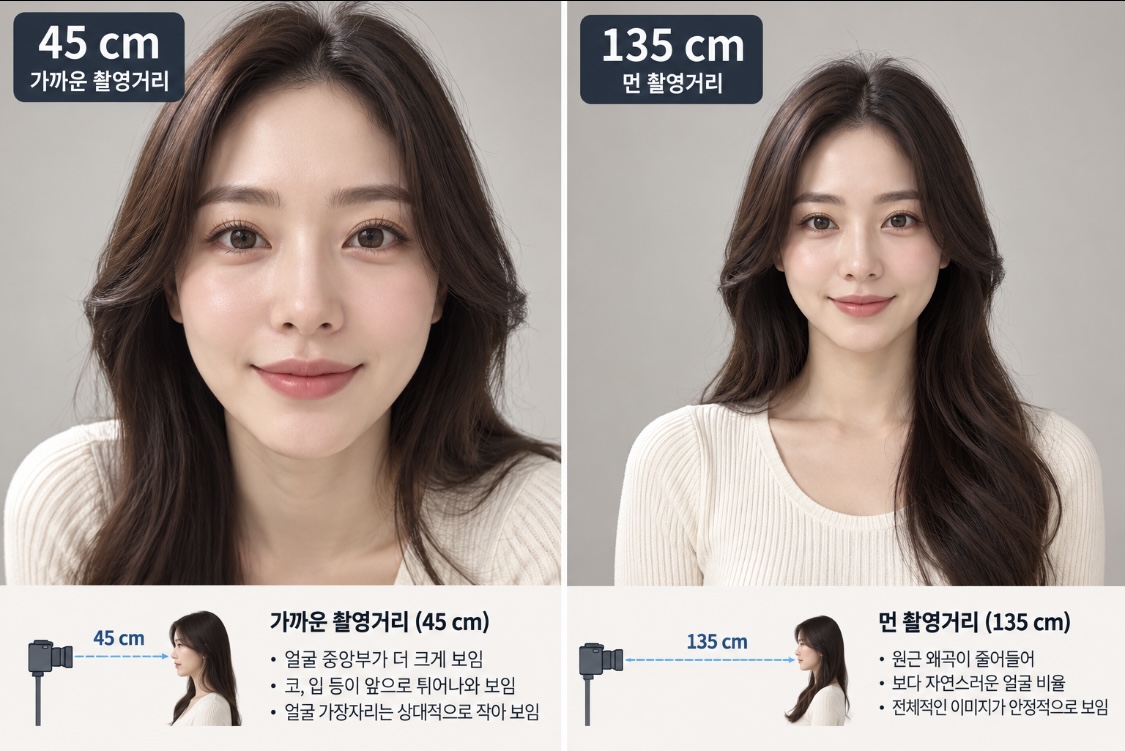
How to read it · The 45 cm and 135 cm labels explain the difference between a close and a distant framing. The overall face size and the amount cropped also differ, so do not measure the effect from one area alone.
Conditions we cannot know · The actual camera position, lens, lighting, and control of expression in this supplied image cannot be confirmed. It should not be treated as an original experimental photo from the paper.
What the research found
Bryan, Perona & Adolphs (2012) photographed the same faces at 45 cm and 135 cm while controlling differences in expression, brightness, and size. In experiment 1b, the farther-distance photo had average rating differences of +5.25 for attractiveness, +2.82 for trustworthiness, and +2.49 for competence over the close-distance photo. These values were normalized from participants' 7-point responses to a 1–100 range by individual range; they do not measure G.STUDIO customer satisfaction or hiring outcomes.
What G.STUDIO Gangnam considers during a shoot
This research supports the possibility that close-range perspective can affect impression ratings. It does not mean that anyone becomes more trustworthy at a particular distance or that 135 cm is optimal for every face. During a shoot, we consider the face, submission purpose, and frame size, secure enough distance, and compare real frames.
Three checks for an ID-photo shoot
- Check whether the camera is too close to the face and whether you can secure more distance.
- First match the face size and front-facing framing required by the submission site.
- Consider expression, face direction, and lighting together, but change one factor at a time when comparing.
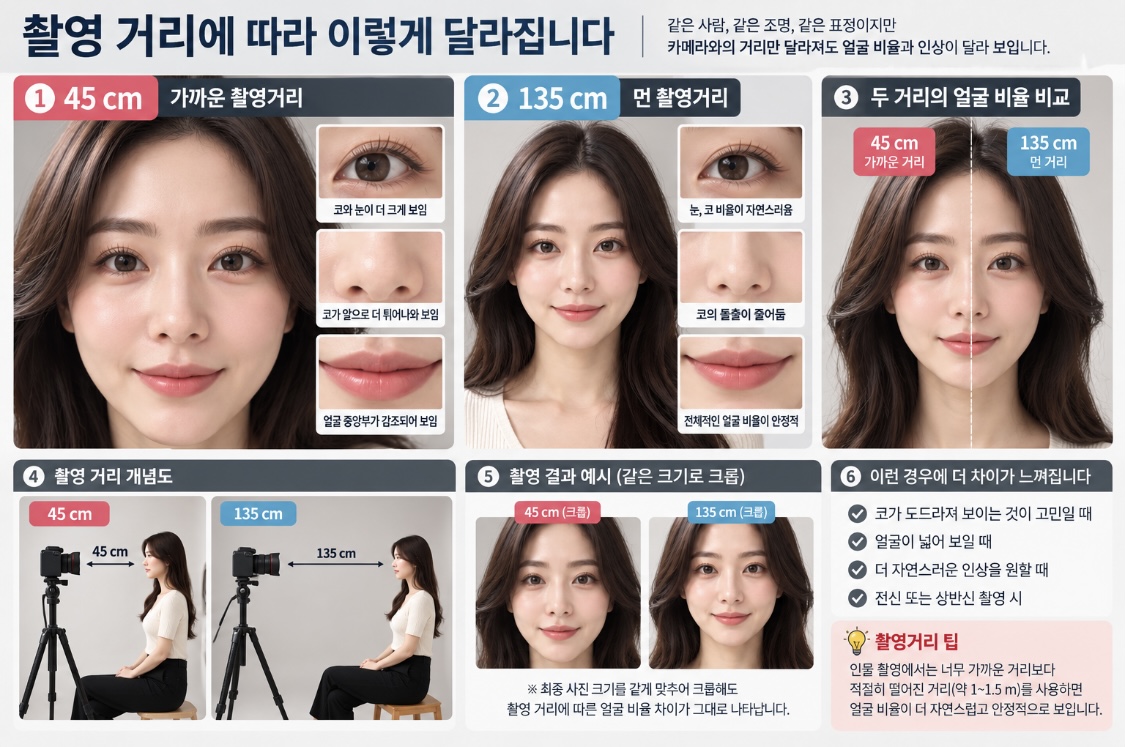
How to read it · It explains that the relative proportions of the center and outer areas can still look different even when the final photo size is matched.
Conditions we cannot know · The actual shooting distance, lens, and retouching process used to create the enlarged panels and composite comparison cannot be confirmed from the image itself. Do not read the displayed numbers as G.STUDIO measurements.
These are the average differences reported by Bryan, Perona & Adolphs (2012). Bar lengths are relative markers for comparing the three values; only the displayed numbers are the actual figures confirmed in the study.
Shooting distance and perspective distortion
Verhoff et al. (2008) examined how changes in the distance between the face and camera can affect facial proportions in passport photos. Of the distances compared, 2 m was selected most often, but the authors noted that this preference was not statistically confirmed and that there is no single optimal distance for every face.
At G.STUDIO, if close-range distortion feels pronounced, we first move the camera a little farther away, reset the framing, and compare the result. For passport and ID photos, the submission site's front-facing, expression, and size rules come before an aesthetically preferred distance.
The relationship between lens and distance
Třebický et al. (2016) observed differences in facial shape and ratings under different focal-length settings. Because camera position and shooting distance used to create the same framing must be considered together, we do not explain facial proportions with the lens number alone, such as “85 mm makes a face look natural.”
When the photographer moves back, the relative distance difference between parts of the face nearer to and farther from the camera becomes smaller, changing the perspective. For a more accurate comparison, keep expression, direction, and lighting as consistent as possible and record distance and framing together.
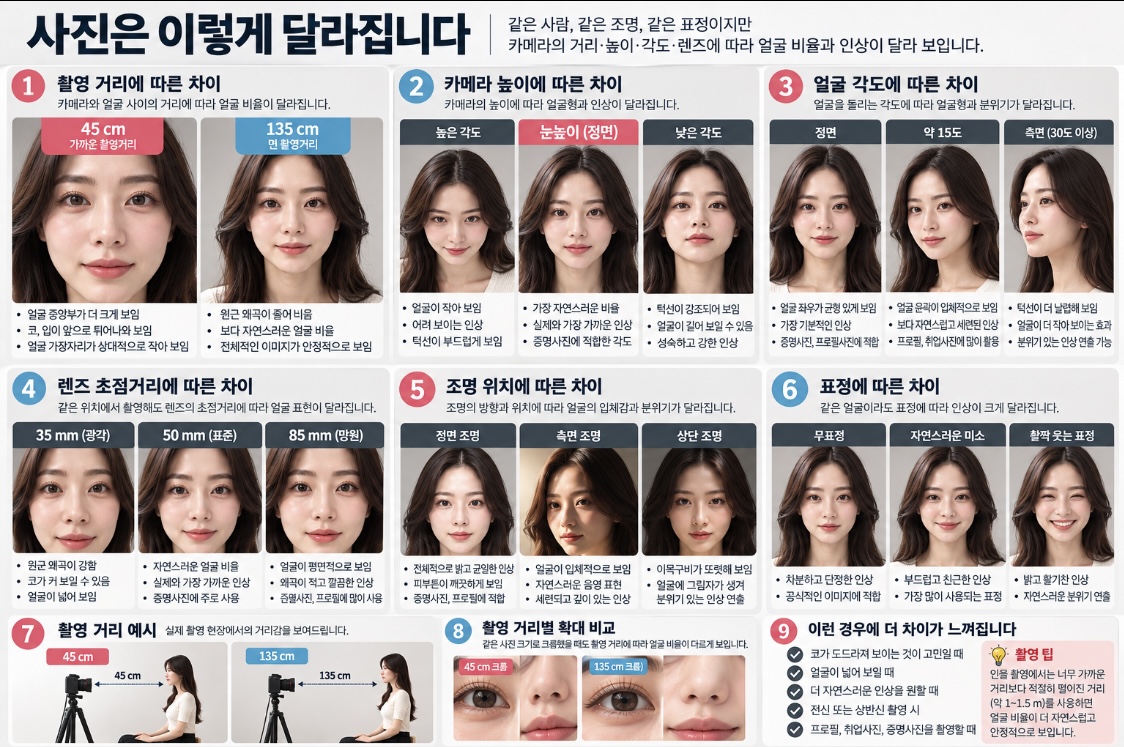
How to read it · Because one image contains several variables, it is a guide not to mix the effects of distance with those of expression and lighting.
Conditions we cannot know · The image does not confirm whether the model, lens, actual distance, and expression were the same across panels. Do not read the example photos as controlled experimental results.
Conclusion
When choosing a studio for ID photos, check facial proportions and camera distance in the unretouched image. At G.STUDIO Gangnam near Gangnam and Sinnonhyeon Stations, we choose distance and framing for the purpose of an ID or portrait photo. Also read why expression, angle and lighting change a photo.
A good portrait is not determined by the lens alone.
It starts with the distance between the camera and the face.
G.STUDIO Gangnam considers facial structure and shooting purpose while checking distance, framing, and expression together. If the result feels unfamiliar, compare it by changing one condition at a time.
Q&A · Shooting distance
Frequently asked questions about shooting distance
Why does a face photographed close up with a smartphone look different?
At close range, the relative distance between parts nearer to the camera, such as the nose, and the ears or outer contour can differ more, making perspective more noticeable. Expression and camera height should also be considered.
Does changing only the lens solve close-range perspective?
If the camera position stays the same, changing only the focal length does not change the perspective relationship itself. The distance between camera and face changes when the photographer moves to match the same framing.
Is 135 cm a good shooting distance for everyone?
No. 45 cm and 135 cm were the conditions compared in that study. In an actual shoot, submission rules, framing, and facial structure are considered together.
What else should you check when the face looks too large?
Compare not only distance but also face direction, camera height, expression, and lighting under the same conditions. Do not determine the cause from a single photo.